Field guide
Permits, Venue Rules and Insurance for Brand Activations
The paperwork behind an activation has hard external deadlines, and it is the only part of the plan you cannot compress.
The part of a brand activation that blows up a timeline is almost never the creative. It is a certificate of insurance with the wrong entity name on it, discovered at the loading dock at 6am. Brand activation permits, venue rules and vendor insurance are unglamorous, sequential, and the only part of the plan with hard external deadlines you cannot negotiate.
Here is the paperwork in the order it actually comes at you, with the lead times that matter.
The five documents a venue will ask for
Almost every venue packet reduces to the same short list. Get these moving early and the rest of the build is yours to control.
- Certificate of insurance. General liability, workers compensation, commercial auto. One million per occurrence and two million aggregate is the standard ask. The venue — and often the host brand and the property owner — needs to appear as an additional insured, with the legal entity name spelled exactly as they give it to you.
- W-9 and vendor registration. Trivial, but some venues will not issue badges without a vendor number.
- Equipment list with electrical draw. Not a list of products — a list of amps. Heat presses each want a dedicated 20-amp circuit, and the facility electrician will ask you to state that in writing.
- Dimensioned floor plan. Footprint, queue direction, egress. If your line will run 40 feet, show where it goes.
- Flame certificates. Any tent, drape, backdrop fabric or table skirt in a public assembly space needs a certificate of flame resistance on file.
Read the exhibitor kit before you design the booth
Convention centres, hotels and private venues run on completely different rulebooks, and the kit tells you which one you are in.
Watch for exclusive vendors. Electrical, rigging and material handling are frequently locked to a single in-house provider, and their advance-order deadline usually sits three to four weeks out. Miss it and the same drop costs meaningfully more on show site. Watch for labour jurisdiction too — in several major convention cities, who is allowed to push a loaded cart across the hall floor is a contractual matter, not a practical one. Budget for it rather than arguing about it at 7am.
Then read the load-in section properly: dock appointment windows, freight elevator dimensions, whether hand carts are permitted through the lobby, and what time the hall goes dark. A press that cannot fit in the service lift is a redesign, not an inconvenience. Our activation planning guide covers the build side of that conversation.
The fire marshal cares about your extension cords
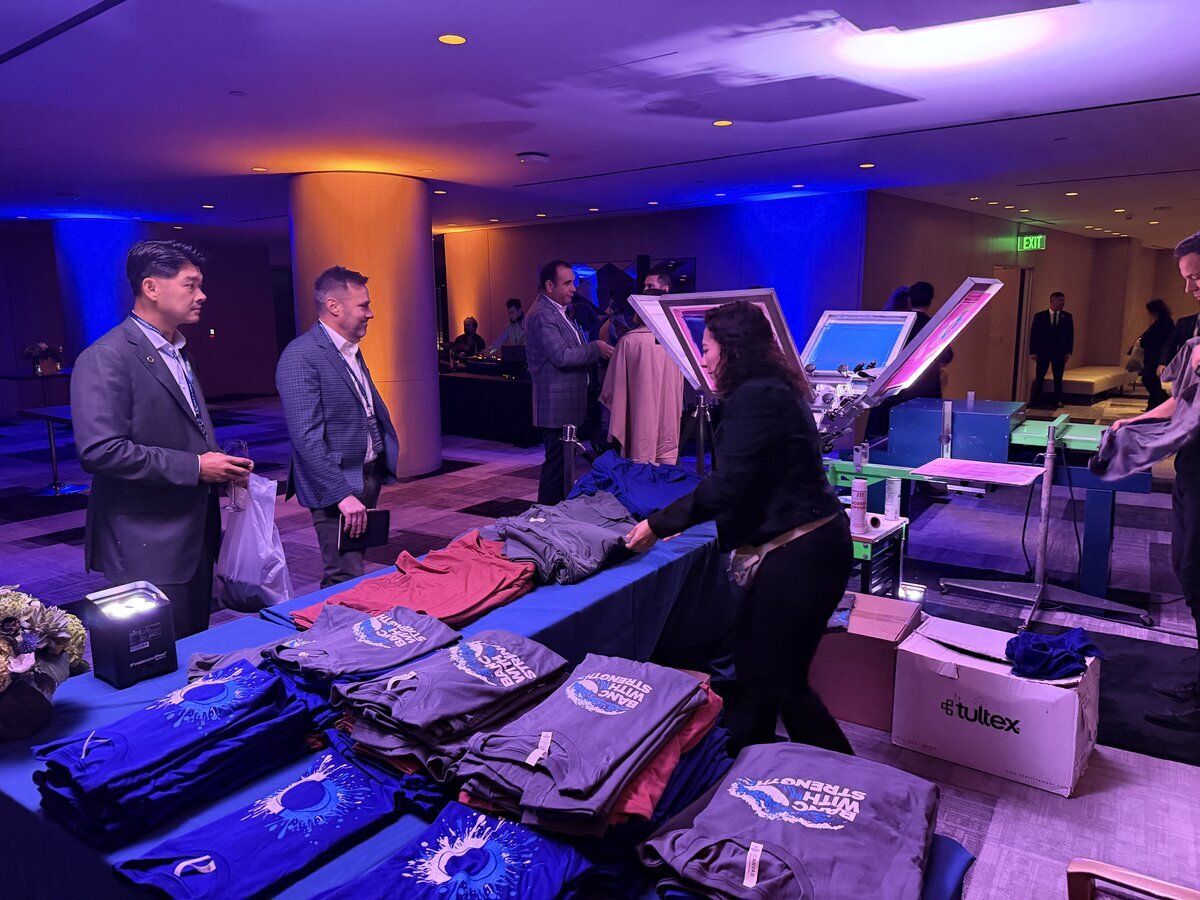
Live printing draws real current and produces real heat, which puts you on the inspector’s list in a way a banner and a bowl of stickers never will.
Plan a dedicated 20-amp circuit per heat press. Two presses sharing one circuit will trip it during the busiest ten minutes of your day, which is a guarantee, not a risk. Use single hard-cord extensions rather than daisy-chained power strips, tape or ramp every cord crossing a walkway, and keep a clear working lane behind the press so an operator is never reaching over a hot platen.
Inspections happen the morning of, before doors. Build so that a walk-through at 8am finds a finished stand, not a half-open road case. The same visit will look for your flame certificates and an accessible extinguisher, so keep both in the front pocket of the case.
When the city, not the venue, is the gatekeeper
The moment your activation touches public ground, a second approval track opens. Parks, plazas, sidewalks and street closures all run through a special event permit, and those calendars are measured in weeks, not days. Some cities also want a temporary business licence for an out-of-town vendor.
Two triggers people miss. First: if you are selling anything rather than giving it away, you likely need a temporary seller permit for that jurisdiction, and the host brand cannot lend you theirs. Second: generators and amplified sound have their own noise rules and permitted hours, which frequently end earlier than your event does.
Private property is easier but not free of process. You still face a vendor packet, insurance requirements and a load-in window — just written by a property manager instead of a city clerk. If the footprint or the power draw is still unsettled, our note on how much space an activation needs is the place to start.
A working timeline
- 8 weeks out. Venue packet in hand. Footprint agreed. City permit applications filed if you are on public ground.
- 6 weeks out. Electrical and material handling ordered at advance rates. Labour confirmed.
- 4 weeks out. COI requested with exact additional insured wording. Flame certificates collected.
- 2 weeks out. Floor plan approved. Dock appointment booked. Crew list submitted for badges.
- 10 business days out. Artwork locked, so blanks and transfers can be produced without rush fees.
- Week of. Printed copies of the COI and permits in the road case. Nobody has ever regretted the paper copy.
That sequence is also why booking lands in the four to eight week window. Compress it and you are paying rush rates on both the paperwork and the goods, which is the fastest way to distort a budget. Our budget guide shows where that money goes.
Frequently asked questions
What insurance limits do venues usually require from an activation vendor?
A general liability policy at one million per occurrence and two million aggregate is the common ask, usually alongside workers compensation and commercial auto. Most venues also want to be named as an additional insured, and many want the host brand named too. Get the exact entity wording in writing, because a certificate with the wrong name gets rejected at the dock.
How early should we request a certificate of insurance?
Three weeks before load-in is comfortable. A plain certificate can be issued in a day, but an additional insured endorsement goes through the carrier and can take a week or more. Ask for it at the same time you sign the venue contract and you will never think about it again.
Do we need a permit for a pop-up on private property?
Usually no city permit, but almost always a rulebook from the property owner. Malls, hotels and office campuses run their own vendor packets with insurance requirements and load-in windows. The city comes back into it the moment you spill onto a sidewalk, close a lane, run a generator or put up a tent.
Send us the venue packet
Forward the exhibitor kit and we will read it, flag the deadlines, and return a compliance list with our insurance and power specs already filled in. Call (562) 614-4800 or request a quote.
The shortcut version: send us the step-1 sentence and the step-2 constraints in the activation brief. Steps 4 through 8 are literally our job, and the quote that comes back within 24 hours doubles as a production plan.
From the blog