Field guide
How to plan a brand activation
The eight-step sequence we walk every client through — written from the production side, where plans either survive load-in or don't.
Every troubled activation we’ve ever rescued had the same root cause: the plan started with the thing (“let’s do a hat bar!”) instead of the job (“we need 800 attendees to remember we exist”). The thing is step four. Here’s the whole sequence, in the order that prevents expensive rework.
Step 1: Name the job in one sentence
“Drive booth traffic at our biggest trade show.” “Make the sales team feel like a unit at kickoff.” “Give launch-night guests something to post.” One sentence, one primary audience, one verb. Every later decision — format, footprint, design count — gets tested against it. If two sentences are fighting for primacy, you’re planning two activations; budget accordingly or cut one.
Step 2: Fix the constraints before the ideas
Date, venue, headcount, hours of service, and budget range. Ideas generated before constraints are fan fiction. The headcount matters most: 150 VIPs and 1,500 attendees point to entirely different formats (embroidery versus two presses), and the venue decides power, space, and load-in reality. If the venue isn’t booked yet, get the activation’s space needs into the venue search criteria — it’s a 10×20 line item, not an afterthought.
Step 3: Budget by outcome, not by line item
Decide what a success is worth before pricing what it costs. If 600 employees wearing the kickoff shirt at the airport is worth $20K to the brand, a $15K activation quote is an easy yes; if you can’t articulate the worth, no quote will feel right. (We published our full allocation framework in the budget guide.)
Step 4: Pick the format to fit the crowd
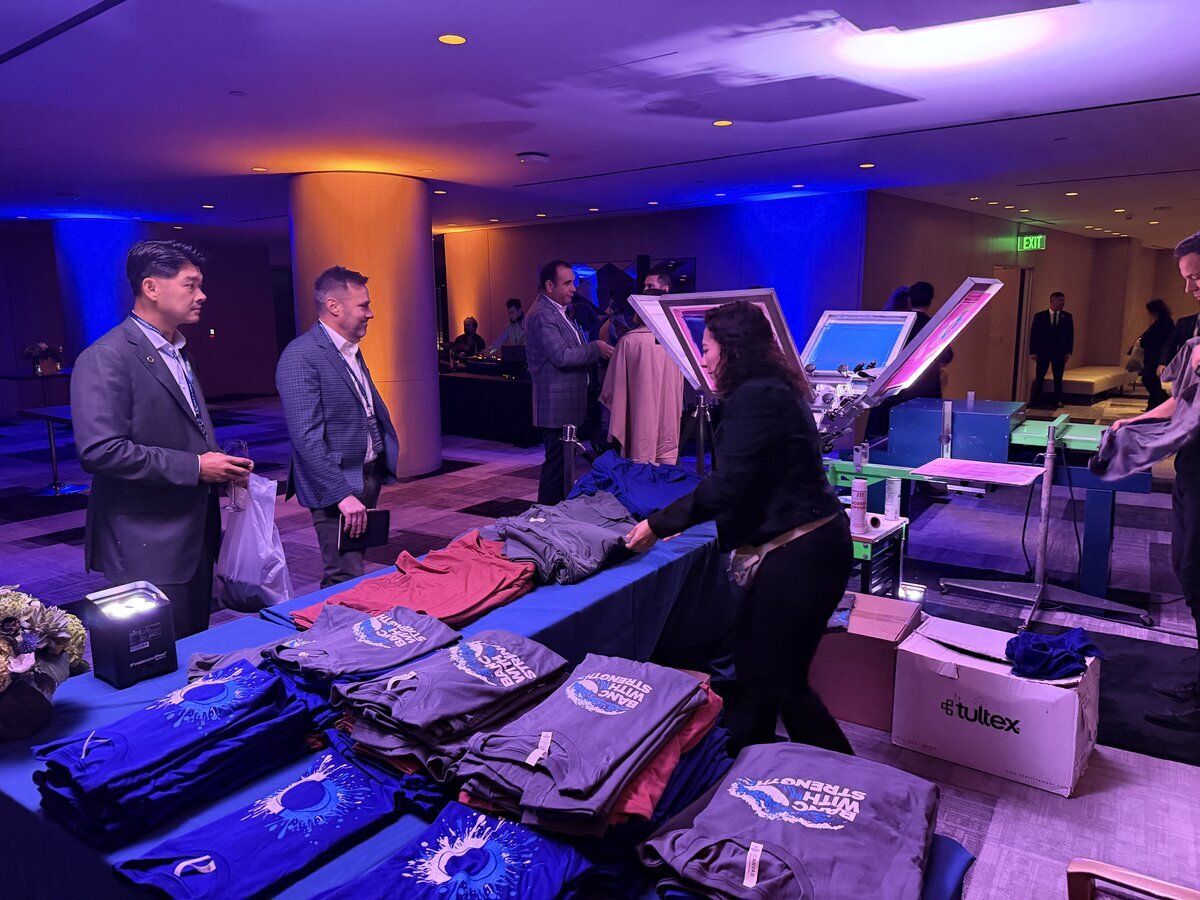
Now the fun part, with guardrails: spectacle and volume → screen printing; personalization → DTF; premium and intimate → embroidery, hat bar, or engraving; useful-object audiences → UV DTF drinkware. Mixed crowds get mixed formats — a volume lane plus a premium lane is our most-booked combination for good reason.
Step 5: Design the menu, not a mural
Two to four designs, sized and placed for the garments you’re actually running, approved by whoever owns brand. Short menus move lines and create the happy agony of choosing; twelve options create stalls. Pro move: one “safe” logo piece, one design-forward piece people didn’t expect, one event-specific mark with the date. Art lock should land a week before the event; our team preps separations and patch layouts from there.
Step 6: Choreograph the guest journey
Walk it as a guest: How do I learn this exists? Where does the line form? What do I do while I wait? Where do I pick up? The wait is programmable space — design selection boards, a second quick-hit station, a photo moment — and the line itself should be visible to passersby, because a queue is the best signage ever invented.
Step 7: Advance the boring things
Power (two 120V/20A circuits for a standard build), load-in path, floor protection, COIs, and a venue contact who answers texts. This is our job, not yours — a good production partner runs the advance directly with the venue — but confirm someone owns it, because day-of surprises always bill at panic rates.
Step 8: Decide what you'll count
Pieces produced, queue participation, badge scans, posts per hour — pick the two or three numbers that map to step one’s sentence, and instrument them before doors. (The full measurement framework is in measuring activation ROI.) Then load out, debrief while it’s fresh, and write down the one thing you’d change — the second activation is always the better one.
The shortcut version: send us the step-1 sentence and the step-2 constraints in the activation brief. Steps 4 through 8 are literally our job, and the quote that comes back within 24 hours doubles as a production plan.
From the blog