Field guide
Why live merch beats swag bags
We've watched both play out from behind the table at hundreds of events. It isn't close, and the reasons are behavioral, not sentimental.
There’s a moment at the end of every conference that swag vendors hope you never witness: the bins by the exit, filling with drawstring bags, stress balls, and pre-printed XL tees abandoned by people who didn’t want to fly them home. We’ve loaded out past those bins a hundred times. The shirts we printed that day were not in them — they were on people, in the security line, at the airport bar. Here’s why the same budget produces such different endings.
1. Choice changes ownership
A swag bag is something that happened to you; a printed-while-you-watch shirt is something you decided. The guest picked the design, the garment, the size — small decisions, but decisions, and decision is the seed of ownership. Behavioral folks call the broader effect effort justification: we value what we participated in creating. The fifteen-minute queue isn’t a cost — it’s an investment the guest makes, and people don’t throw away their investments at the exit.
2. The making is media
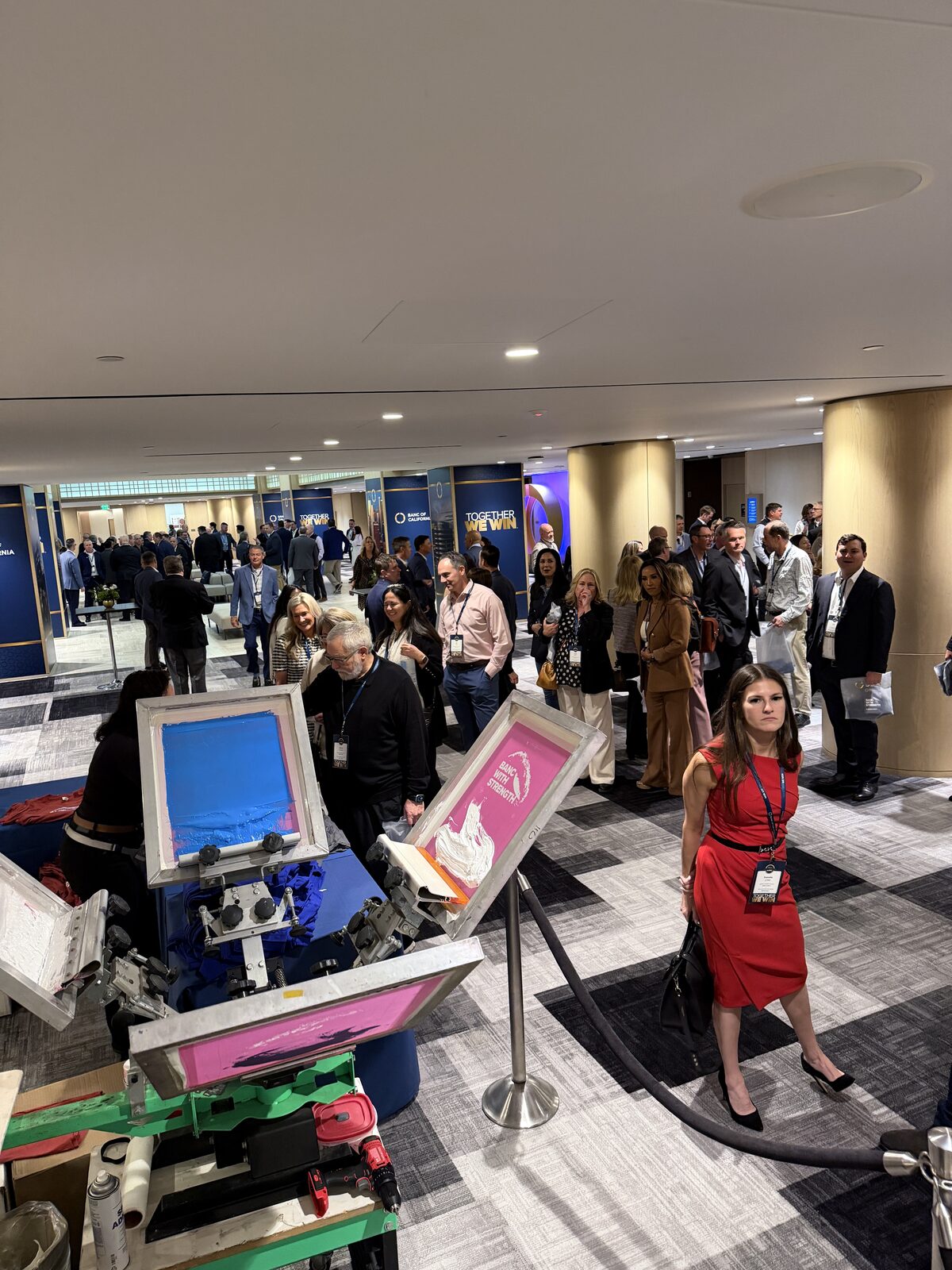
Nobody films a tote being handed over. Everybody films a squeegee pull. Live production converts your merch budget into a continuous performance — ink flooding a screen, the flash cure, the reveal — and every guest video of it is distribution you didn’t buy. A swag table generates zero seconds of content; a press generates it for hours. (This is the engine behind every idea in our booth-traffic guide.)
3. The queue is social proof with feet
A line is the only signage that recruits its own readers. Attendees who’ve never heard of your brand join queues on pure curiosity — whatever they’re waiting for must be worth it — and then spend ten minutes inside your footprint, which is ten more minutes than any swag table earns. Trade-show teams can convert that dwell time directly: badge scan to claim, demo to skip the line, QR to pick your design. The merch is the incentive; the queue is the funnel.
4. Sizing on demand kills the waste
Pre-printed orders force a guess at the size curve months out, and the guess is always wrong — that’s why the leftover boxes exist. Printing on demand means every garment leaves in the size that was asked for, in the design that was chosen. Nothing to warehouse, nothing to ship home, nothing in the exit bins. Procurement and sustainability teams arrive at the same conclusion from different directions.
5. Worn merch compounds; bagged merch doesn't
The economic difference shows up after the event. A kept shirt is worn dozens of times — office, gym, airport — each wear an impression among exactly the wearer’s own social graph, the most credible targeting on earth. The swag-bag tee that never fit never enters circulation at all. Same logo, same cotton; the only variable was how it was acquired. We walk through the full math in measuring activation ROI.
The honest caveats
Live printing has real constraints: it needs footprint and power, it serves hundreds-per-hour rather than infinite-per-instant, and it costs more than bulk pens — $7.5K–$30K for most activations. If the job is “put something in 10,000 hands in one afternoon,” bulk swag still has a seat. But if the job is being remembered, worn, and posted — the contest ended a long time ago, somewhere around the third abandoned drawstring bag.
From the blog