Field guide
The brand activation budget guide
Where the money actually goes, how to allocate it, and the three places where saving $2K reliably costs $10K in outcome.
Activation budgets fail in two directions. Underfunded ones produce a sad table that damages the brand it was meant to boost. Overfunded ones spend $80K building a set for an experience guests would have loved at $25K. The fix for both is the same: know what each layer of the budget buys, and allocate by job. Here’s the framework we use when clients ask us to sanity-check their numbers.
The anatomy of an activation budget
Most activations are built from five layers. (1) The experience core — whatever guests actually do; for live printing, that’s the crewed stations, equipment, blanks, and art prep, which is why our quotes bundle them as one number. (2) Environment — booth structure, signage, lighting, furniture. (3) Real estate — the floor space, sponsorship tier, or venue buyout. (4) Amplification — content capture, influencer seeding, paid boost on the footage. (5) Contingency — the 10% that turns surprises into anecdotes instead of crises.
What the experience core costs
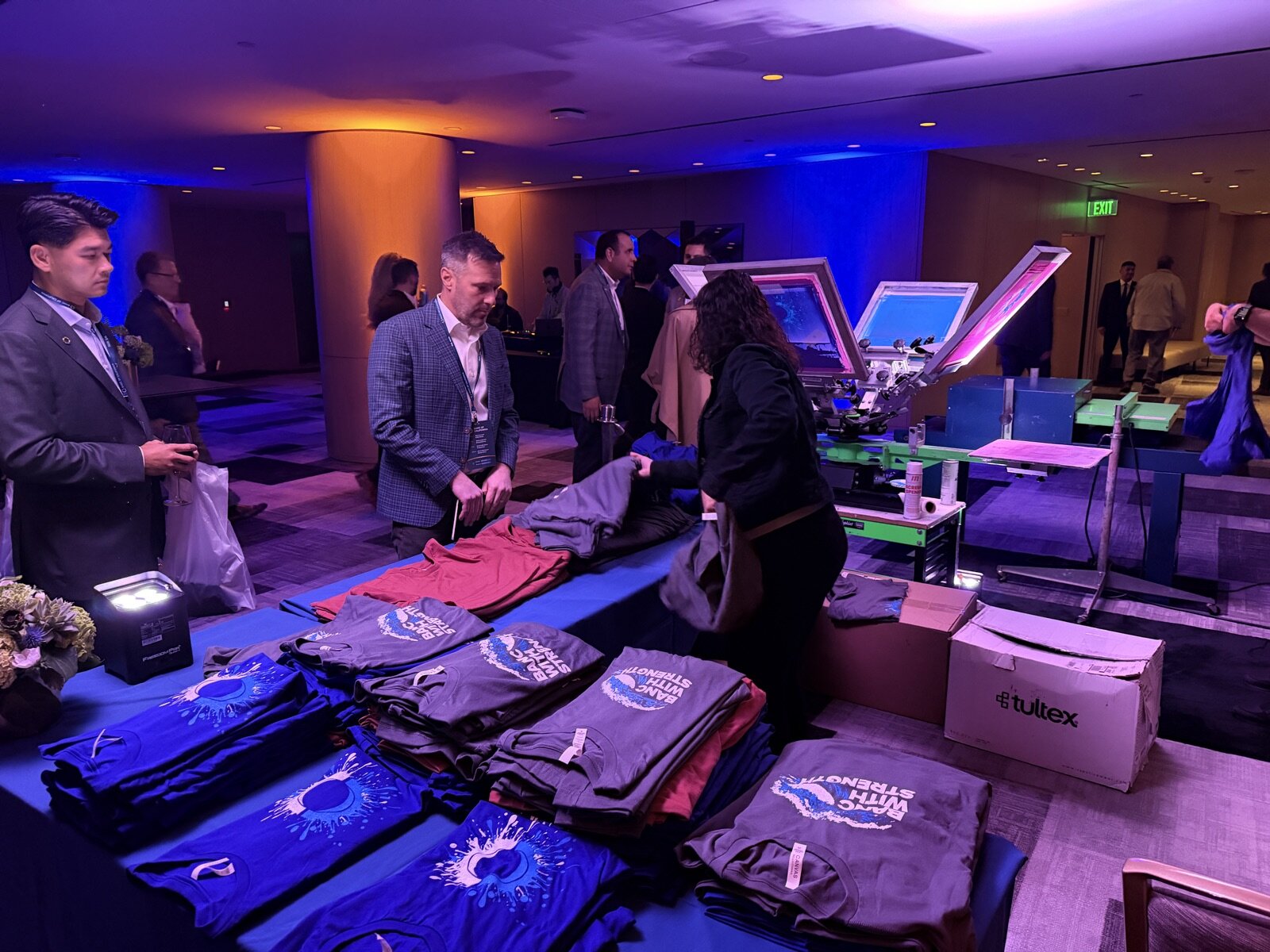
For live merch printing, most activations land between $7,500 and $30,000 all-in: crew, presses and stations, retail-quality garments, and print-ready artwork included. The levers are guest count, hours, format mix, and travel — we’ve published the tier-by-tier breakdown on the pricing page and in the cost answer. The honest comparison point: a decent pre-printed swag order for 800 attendees often costs $8K–$15K anyway. The activation premium buys the queue, the show, and the keep-rate — not the shirts.
Allocation ratios that hold up
- Experience-first events (conference activations, employee events): 50–60% experience core, 15% environment, 10% amplification, 10% contingency, the rest real estate.
- Trade shows, where real estate is pre-committed: of the remaining spend, put 40–50% into the experience — the booth without a reason to stop is the most common five-figure regret in B2B marketing.
- Launch moments built for content: amplification rises to 20–25%, because the activation is partly a film set; brief your crew on camera angles and the “peel moment” timing.
The three cuts that backfire
Cutting garment quality. A $3-cheaper blank that nobody wears twice deletes the entire post-event media value — the worn shirt IS the ROI. Cutting crew. Understaffed stations cap throughput, and the line you wanted becomes the line that walks away; the math on a second printer is almost always favorable. Cutting pre-production. Skipped site advances and rushed art create day-of failures that no amount of on-site hustle fixes. Cut design count, cut hours, cut the booth structure before you cut any of these three.
Where you CAN save without bleeding
- Shorten the service window to match real traffic peaks — four sharp hours beat eight thin ones.
- Narrow the design menu — two great designs out-perform five mediocre ones and print faster.
- Book SoCal when you have the choice — Orange County, LA, and San Diego carry no travel fee on our quotes.
- Reuse the art system across a season of events — pre-production amortizes beautifully.
One more allocation note that saves arguments later: decide up front whether the merch budget lives inside the activation line or beside it. Teams that compare a live-printing quote against “booth entertainment” alone forget the quote already contains the garment spend they were going to make anyway — netting it out usually shrinks the perceived premium to a fraction of the sticker difference.
Final advice: get real quotes before locking the internal number. Budget lines invented in a planning doc have a way of being 40% off in both directions. Ours takes two minutes to request and comes back line-itemed within 24 hours — even if you only use it to calibrate.
From the blog